
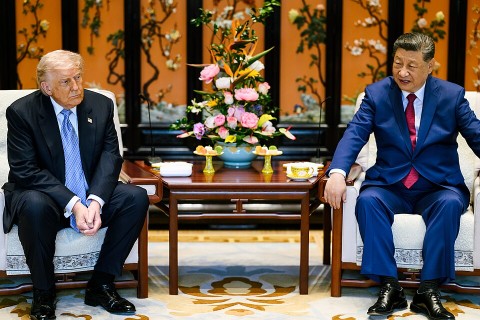
China has issued a stern warning to the United States regarding the sensitive issue of Taiwan, following former U.S. President Donald Trump’s announcement of his intention to communicate with Taiwan’s leader, Lai Ching-te. This potential interaction has raised tensions, as Beijing is particularly sensitive to any high-level contacts between U.S. officials and Taiwan’s government, given China’s stance on Taiwan’s status.
Beijing considers Taiwan a part of its territory and opposes any formal engagement between foreign governments and Taiwan’s leadership. China insists that Taiwan is a breakaway province and has expressed its resolve to reunify Taiwan with the mainland, using force if necessary. The Chinese government frequently condemns international diplomatic efforts that treat Taiwan as a sovereign entity, labeling them as interference in its internal affairs and sending misleading signals to proponents of Taiwan’s independence.
In recent years, the situation around Taiwan has grown more fraught. After a U.S. official visited Taiwan in 2022, China responded with extensive military exercises in the region. Additionally, Beijing has consistently reacted negatively to U.S. arms sales to Taiwan and political support extended to the island. These actions have further fueled the ongoing tensions between the two nations over Taiwan’s status.
Despite Beijing’s claims, Taiwan operates as a self-governing democracy, officially known as the Republic of China. Its government denies Beijing’s sovereignty claims, asserting that its citizens have the autonomy to elect their own leaders and engage in international relations. The United States, meanwhile, upholds the “One China” policy, which officially recognizes Beijing while maintaining unofficial relations with Taipei. Under the Taiwan Relations Act, Washington continues to provide Taiwan with defensive weaponry.
In 2016, Trump previously engaged in a rare direct conversation with then Taiwan President Tsai Ing-wen, leading to sharp criticism from China. Should Trump proceed with his call to Lai, it could exacerbate the already strained U.S.-China relations and potentially invite a fresh wave of Chinese military maneuvers around Taiwan. The situation underscores the delicate balance the U.S. must navigate in its interactions with both China and Taiwan.