
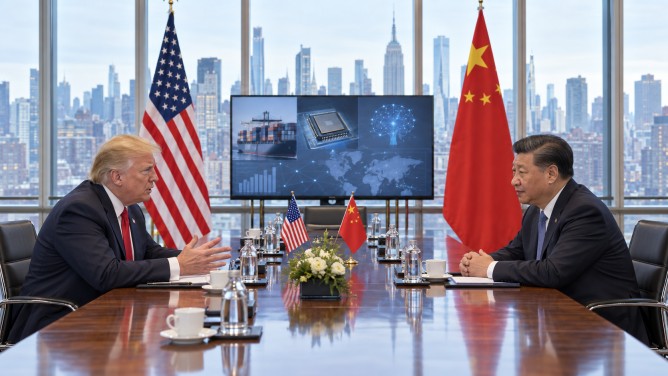
As the world’s two largest economies grapple with ongoing tensions, the United States and China have engaged in crucial discussions aimed at preserving a fragile trade truce. These talks, which took place in New York, precede an anticipated summit between US President Donald Trump and Chinese President Xi Jinping, where trade, investment, and technology are expected to be central topics.
Leading the recent negotiations were US Treasury Secretary Scott Bessent and Chinese Vice Premier He Lifeng. Both nations are exploring methods to mitigate trade barriers, including tariffs and export restrictions that impact American energy and agricultural exports. These efforts underscore the broader objective of maintaining economic stability and cooperation between Washington and Beijing.
In addition to trade, the rapidly advancing field of artificial intelligence (AI) has emerged as a significant point of contention. US officials and tech companies express concerns over Chinese firms allegedly developing AI systems with technology sourced from American models. China, however, dismisses these allegations, opposing any measures perceived as attempts to stifle its burgeoning AI industry. As part of the ongoing dialogue, officials are expected to discuss strategies for managing technological risks while preventing further divergence in their tech sectors.
As the Trump-Xi meeting approaches, the agenda is likely to cover the overarching economic and strategic relationship between the two countries. This includes addressing trade limitations, technological rivalry, and other shared issues that have long shaped the bilateral ties. The outcome of these discussions could have significant implications for international economic relations and technological development.