
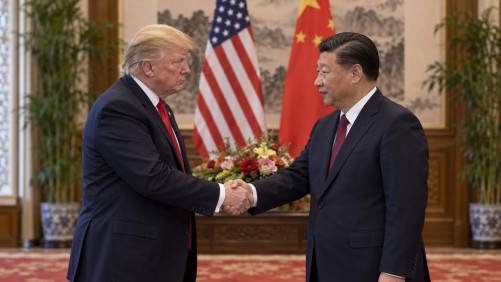
As the geopolitical landscape remains tense, the United States and China are preparing for crucial talks aimed at addressing several contentious issues, including trade, artificial intelligence (AI), and Taiwan. The meeting between US President Donald Trump and Chinese President Xi Jinping will take place in the United States, marking their second face-to-face encounter this year. Despite ongoing efforts to mend relations, both nations continue to grapple with significant disagreements, leaving little hope for major breakthroughs on the most divisive topics.
Artificial intelligence is expected to be a central theme in the discussions. The United States has put forward a proposal to establish a framework for dialogue with China on AI safety and governance. Meanwhile, China has expressed interest in enhancing cooperation in this burgeoning field. However, both sides have divergent perspectives on the risks associated with AI and its development. The US has implemented restrictions on China’s access to advanced semiconductors crucial for AI, a move Beijing perceives as an attempt to stifle its technological advancement.
Trade relations will also be a prominent topic on the agenda. The existing US-China trade agreement, which includes tariff measures and limitations on Chinese rare-earth exports, is set to expire in November. While Beijing seeks a more stable long-term trade relationship, Washington views these restrictions as leverage in ongoing negotiations. The potential expiration of the agreement adds urgency to the discussions, with both nations having much at stake economically.
The situation surrounding Taiwan continues to be a significant point of contention. The United States has traditionally supported Taiwan through defense ties, a stance that China strongly opposes, viewing Taiwan as part of its territory. As future US arms sales to Taiwan loom as a sensitive issue, it is likely to feature prominently in the Trump-Xi dialogue.
Beyond these bilateral issues, the meeting will also touch on broader international concerns, such as conflicts involving Iran and Ukraine. China’s economic ties with Iran and its close relationship with Russia are areas where the two leaders might seek common ground or, at the very least, mutual understanding. As both nations navigate their strategic rivalry, maintaining open lines of communication on matters affecting global trade, technology, and security remains crucial.