
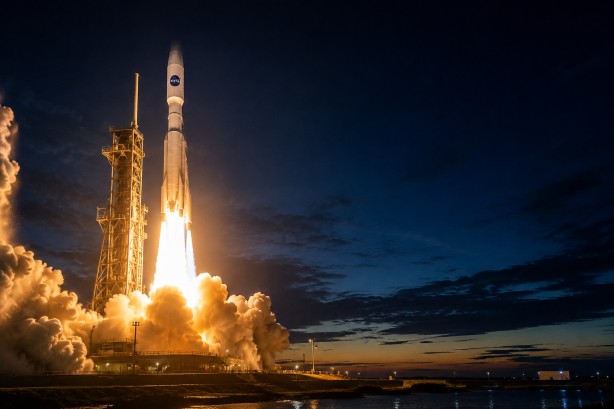
Embarking on a celestial journey, NASA’s Nancy Grace Roman Space Telescope has successfully lifted off from Florida, setting its course toward a location nearly one million miles from Earth. This $4.3 billion observatory is poised to delve into the exploration of exoplanets, the formation of planets and galaxies, and some of the universe’s most profound enigmas. Launched aboard a SpaceX Falcon Heavy rocket from the Kennedy Space Center, this mission signifies a pivotal step forward after nearly a decade of development.
The Roman Space Telescope is not intended to replace the Hubble and James Webb Telescopes but rather to complement their efforts. Equipped with a formidable 300-megapixel infrared camera, it promises to deliver images with a resolution akin to Hubble’s while covering a field of view that is at least 100 times greater. Each image will capture an expanse of the sky approximately 1.5 times the apparent size of the full Moon. One of the telescope’s standout features is its coronagraph, designed to mask the overwhelming brilliance of stars, allowing scientists to examine orbiting planets with unprecedented detail.
Once it reaches the Sun-Earth Lagrange Point 2, a stable space location shared with the James Webb Space Telescope, Roman will embark on a diverse array of observations during its anticipated five-year primary mission, with the possibility of extension. Researchers are hopeful that the data gathered will shed light on dark matter, dark energy, distant galaxies, supernovae, black holes, and planets beyond our solar system. Its wide-field imaging could also pinpoint targets for more focused studies by Hubble and Webb.
In the wake of its launch, the first scientific images from Roman are projected to arrive in early 2027, following a period of rigorous testing and calibration. NASA is committed to making these images publicly accessible, offering a wealth of astronomical data to both professional researchers and amateur stargazers alike. The mission’s success is particularly significant given the challenges it faced, including proposed budget cuts to NASA’s science programs. Although there were initial attempts by the White House to scrap the project, Congress ensured its continuation by maintaining the necessary funding.
With this launch, the Roman Space Telescope opens a new chapter in NASA’s quest to unravel the mysteries of cosmic expansion, planetary formation, and the evolutionary history of the universe over billions of years. As Roman embarks on its mission, it promises to enrich our understanding of the cosmos with its groundbreaking observations and discoveries.